In memory of Samuel Newey
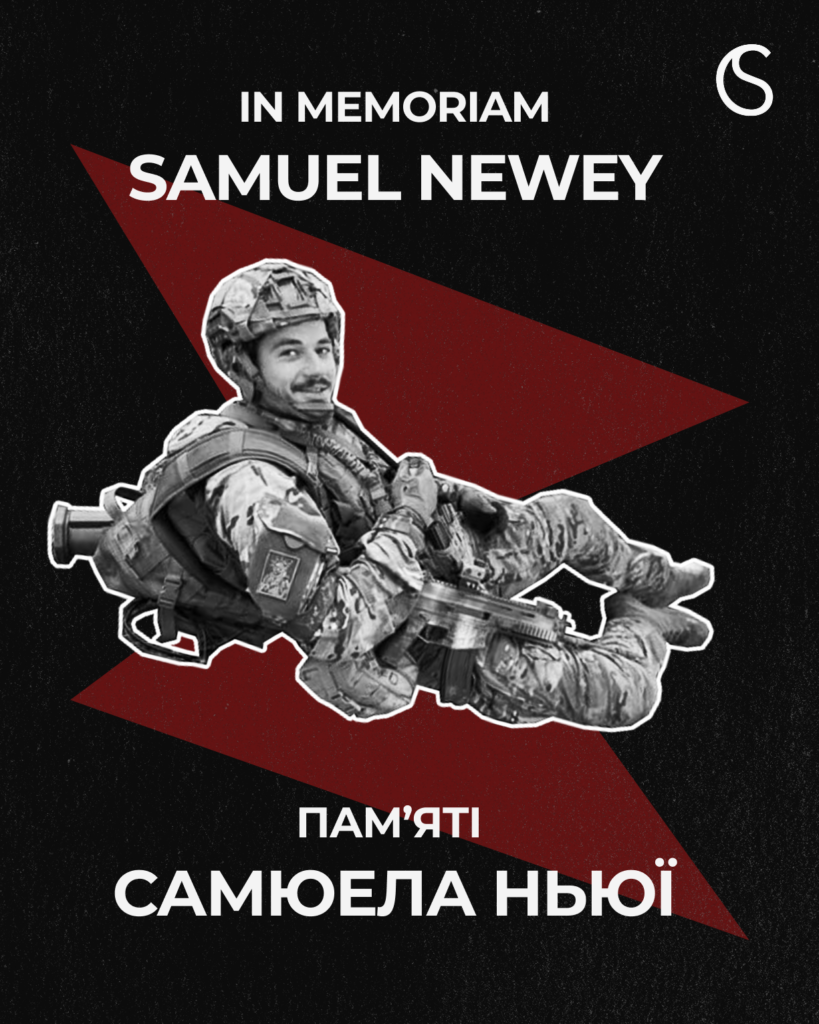
On the 30th of August 2023, Samuel Newey was killed in action in Ukraine fighting the Russian invasion. He was killed while serving with an infantry group that he had joined that same summer. Today marks the fourth year that his loved ones have to live without him, the fourth year that we all have to continue the struggle without him. But the mark he left on each of us who met him, his path in life, and his determination to fight against injustice are still blowing in the wind.
It’s not so often that we have the chance to hear new words from the dead. But today we want to offer this chance to everybody, to celebrate his life. We would like to share this interview with him, recorded in the summer of 2023 and never published.
Death is part of our social life, and remembering the comrades who died, why they fought, how they lived, and how they thought is essential to the continuity of our struggle. So, among all the voices of our dear comrades who cannot speak except through our memories, their texts or recordings, let’s relish the chance to read Samuel’s thoughts on what was happening here in 2023.
In loving memory.
Disclaimer: Publishing this interview is an act of remembrance and a tribute to Samuel’s life; it does not constitute an endorsement of, or agreement with, everything expressed in it. Solidarity Collectives may hold different, critical views regarding some of Samuel’s opinions and statements.
How did you come to the decision to go to Ukraine?
It was one of those situations where I can sit here and not do anything or I can go out and at least try something. So I just sat there for about a week after the war started. And then I was just like, okay fuck it, I’m just going to go buy myself a flight and get out there. I just sort of fell into all of this. In all honesty, I just wanted to come out and do humanitarian work, help bring supplies. As soon as I stepped off the train, I got pulled into the Georgian Legion. And then I left there, because that place is crazy and full of idiots. I decided to try my hand elsewhere.
In the start, it was a lot more chaotic than what it is now. Now, there’s a little bit of structure and order, which is still pretty chaotic. It’d be a lot harder for someone to just come over and get involved. Whereas before, you just sort of get off the train and there’s like 50 dudes trying to get you to go with them.
Who are you serving with? How are international volunteers organized into the Ukrainian Armed Forces?
When I initially came out, I worked only with Ukrainians in a Ukrainian unit. The organizers put me where they wanted me, and I ended up in reconnaissance. The internationals are everywhere around Ukraine. There are some in Ukrainian units. There are some in the Foreign Legion units; they’re just everywhere. I’m in a foreign unit right now, and we just fly drones. Up until about five months ago, I was with a combat team, and then I went over to the drone side. I’m looking to go back to the combat side.
How did it feel to go into combat?
Honestly, I wasn’t scared or fearful. It was just like going to work because I don’t really care. I felt that I was meant to be there, and what will be will be. Before I came to the country, I thought about the consequences of my actions, my potential end. I was willing to accept that.
What did you do before the war? How were you politicized?
Before Ukraine, I did butchery for like three or four years; before that I was homeless, and then before that I was at school, obviously. My brother went to Rojava and spent a fair few years out there. That’s where my politics are formed, through the family. My grandmother on my dad’s side comes from a long line of gypsy spiritual mediums, and naturally they’re all poor and working class. And then my grandmother on my mom’s side was a Polish Jew. So my politics were very much formed when I was born: there was always going to be only one route.
Do you feel attached to a particular political lineage?
Before coming out here, I would have said 110%, I’m an anarchist. But after coming here, I don’t know anymore. I’m a bit politically confused. I haven’t had the time to keep revising, keep reading, and trying to figure out where I want to be and how I want to be in life. So that’s something that I need to keep trying to figure out myself. So I’m not at the moment. I don’t really think there’s any political ideology currently out here that represents the people. I think it’s very hard. And I think people are inherently corrupt. So anything like anarchism, or communism can just get hijacked by that one percent of the people that strive for power, and I think there needs to be checks. I’m not sure how to do that at the moment.
How do you see what you’re doing in relation to other examples of international solidarity?
I feel very much like George Orwell while he was in Catalonia, to be honest. All the problems he talks about in Homage to Catalonia, I feel like we encounter as well. So, I think the Spanish Civil War definitely resonates here. It’s something that my brother always spoke about, and it’s something I’ve read quite a fair bit about.
What are the other international volunteers like that you’ve met?
There are absolutely crazy people. Some people are just lost. Some are here for ideological reasons. You’ve got people here because they don’t know what else to do in life, and you’ve got people that are here to make money. I remember early on in the war, there were like loads of Colombians, and for the most part, those I spoke to were just here for the money. They were getting almost $3,000 a month. But a lot of them went home because they’re just out here to support their families. They’re not here to die.
So, it’s a very mixed bag. I’d say, the best people out here, in my opinion, funnily enough, are people here for ideological reasons – communists, anarchists, and even the Nazis – because we all understand we have to work together for the moment. They are people that don’t really falter on the battlefield, whereas people who are here for selfish reasons, and not so much for their ideological beliefs, tend to come get loads of money out of the country and go.
And have you met other leftists?
Oh yeah, there are loads out here. It’s awesome. We’ve got like a huge network across the country. And that’s beneficial to everyone: it’s good to know that you’ve always got someone you can rely on. And there are like seven people in my unit, out of a few dozen that are aligned with me [politically].
Why do you think it’s important for foreigners to take up this fight?
There are ways of showing support, of course, from outside the country, like bringing in supplies and things like that. But I think the real essence of internationalism is to look to your left and look to your right, and someone you might not know, who might not speak the same language as you, but is there on the same ground with the same beliefs as you. I think that’s very important to all people. And it’s a relief to a lot of people when you go up on the front line, and they’re asking, ‘Why are you here?’ and you say: ‘To support you’. That’s one of the best things out here, just seeing people’s faces when they realize they’re not alone.
How do you relate to the politics of Ukraine and all the different factions involved in the defense?
I think there’s going to be a civil war after the war. To be honest, I think there are too many political groups that are armed to the teeth and have loads of combat experience in a pretty small country. It’s only 40 million people, so it’s quite a small population. You’ve got all these opposing political views who are armed to the teeth, and they’ve all done X amount of years of solid war. I think there’s probably going to be a problem because they’ve all got different directions of how they want the country to go.
And what about the involvement of far-right factions within the armed forces?
They’ve got massive amounts of power. But then they played a huge role in politics before the large-scale invasion. So, it’s going to be very interesting to see where it goes.
Everyone tries to avoid talking about politics because, at the moment, people don’t have time to think about politics. That may come in the future, but you’ve got to focus on not dying in the moment. In my opinion — and other people might have opposing opinions — I really don’t care who’s next to me. I just don’t want to speak to them about things that I don’t want to hear about. There’s no point in having lots of fighting among units, while the supposedly second most powerful army on earth is trying to kill you all. It’s better to deal with it all after the war.
I think there’s a lot that the people outside the country can’t even fathom unless they were here. It’s easy to sit outside the country and to judge what’s happening or to say you shouldn’t work with X, Y, and Z because of X, Y, and Z. And that’s a problem within left-wing factions: there’s too much infighting all the time because everyone has their own opinion and their own view of how to do things. And in situations like this, it doesn’t work. You can’t say I’m not going to work with him or do this for him because of this or that, because it will lead to people dying.
How long do you think you’ll stay?
I’m staying until the end. I’ll probably stay for the civil war that potentially comes afterwards as well.
And beyond that?
I want to start some small businesses, I think, start some small business at the end of the war and try and help rebuild villages and things. Just try to generate as much money to rebuild the towns as possible. And then after that, I’d stay here and volunteer for as long as I can, and just try to keep people interested in helping the people of this country.
I love them. They’re just simple people that want peace and a simple life. They’re awesome people, the nicest people in the world. They’d give you that block, that last bit of food. If you say you’re hungry, they’ll make sure you’re taken care of.
I’m not sure what I’m really doing after that. It’s a beautiful country, honestly.
When do you go back to the front?
That’s unknown. We’re supposed to be on a leave period, but I just want to keep training or doing something. I’m not sure if we’ll be going back out east. I’m not sure where we’ll be going. It’s just wherever they want us, whenever they say.