Interview with Hayka
Tell about your service; what are you currently doing?
Right now I’m finishing up the last day of my vacation. And when I get back, I’ll be doing my work vectors.
One of them is a medical one, but there are no medical positions at the level of my company. We have a combat medic, and I am his assistant and a part-time medic.
What is included in the spectrum of my duties: we conduct classes together with this combat medic for our personnel from the medical unit. And these are not just basic classes on stopping bleeding, because it seems that everyone already knows everything about it.
We dive a little deeper and even move away from MARCH into the next algorithms, study pharmacology with the soldiers, intravenous access. We always think over the scenarios of these classes together, plots that can be worked out with the soldiers.
We also constantly check what is in the individual first-aid kits of our fighters, before and after the exits. We also try to equip the positions with everything necessary.
That is, in addition to IFAKs, each of our firing positions also has a separate bag filled with various medicines that may be needed there. People who sit in basements, dugouts, trenches for a week can get stomach problems, freeze and catch a cold.
In general, many people know that the supply of medicine from official sources can be bureaucratically complicated. And therefore we are constantly arranging something, starting from simulators for all these classes and ending with just some medicines that may be useful to our fighters. We constantly monitor what can be obtained and received where.
My second vector is just a life of an ordinary infantry fightress, who goes to positions as part of a grenade launcher. I go with the soldiers to the positions and spend time there defending the river bank.
And from time to time I am assigned for administrative work, I fill out various logs – weapons checks, personnel checks, there are jokes that there is so much bureaucracy in the army that there is a logbook of a logbooks, this is partly true, you have to fill out a lot of logs that may have nothing to do with reality, but, unfortunately, these are the rules.
And my main position, where I spend most of my working time, is to be a duty officer at the command and observation post.
Every 48 hours I go underground and take over on duty. This is a space where there is a radio, many screens, and you have to monitor the situation that is happening in the sky, because there are certain devices with which you can track what is and what isn’t flying at us, and also staying in touch with our firing positions.
That is, when I am in position, I just go to this command and OP, if something happens or there is some request, and when I am not in position, I receive these requests on the other side, when the situation escalates, something needs to be transmitted, I constantly have to sit as a signalman.
If I am asked to do something else in the army, to kill fleas or rats in the basement, then I do that too.
But even taking into account that you have several areas of work, and they are all quite different, does your position remain one official one, which is written in the military record?
Yes, I am a grenade launcher crew member.
This is my official position, which is written in the military record – that is, to carry shells, and that’s it.
In your opinion, is this due to the fact that everything in war is so fleeting that everyone has to do everything, or is it just that someone from above is too lazy to write these positions into military records?
It seems to me that it is both. And perhaps it is a little related to my own initiative and energy level.
I could do one thing, that would be enough. I am sure that no one would tell me “you are not doing enough”. But I am simply a person in my own right, who, if I dive in, is ready to do a lot of things, I do not see an upper limit in this.
There are things that I would like to improve, to try to take the initiative in this, but the transformation process in the army is very slow.
Almost a year passed before I was even allowed to be let to positions, and I think, with the ambitions that I have, I just need to wait a little longer for them to also immerse me in those things.
So you expressed a desire to go to positions all year?
Of course. The commander even sent me to the ass – he said it directly. And in the middle of the dialogue, when I tried to talk about it, he just turned around and left.
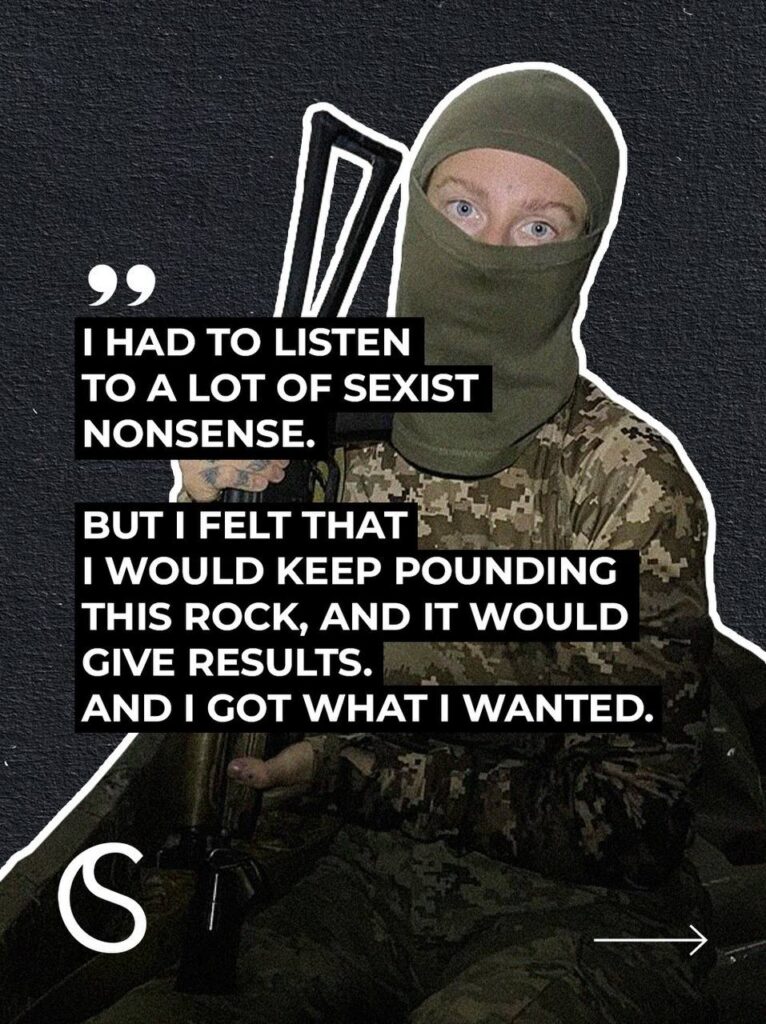
I had to listen to a lot of sexist nonsense. But I felt that I would keep pounding this rock, and it would give results. I worked hard, and I got what I wanted.
So it took you a year to gain trust in yourself, and everyone recognized that you were capable and worthy of doing everything that other men do simply by the fact [of your gender].
I think they were able to see something beyond the fact that I was a chorus girl, and that I was capable of more.
How did you join the army, and what influenced your decision to go to war? Was there a turning point for you, or was it perhaps obvious to you from the very beginning?
Looking back, it seems obvious to me, and if I had the opportunity to relive the events of my life, I would have done so back in 2014.
But then, hostilities began in my Luhansk region, I was still raised in a conservative Jehovah’s Witness family, and apoliticality was strongly promoted there.
The war was palpable in my city, Rubizhne, and there was even a short-term occupation, but as if behind the veil of this religious Christianity and humility, when you turn the other cheek to the enemy and all that, I didn’t seem to understand what was happening in Ukraine at all.
We didn’t experience this ourselves, when Russia changes the currency to rubles, destroys Ukrainian textbooks, and runs around distributing Russian primers to schools. These were weeks of some kind of depressive state and apathy in the city, and then we woke up, and we had Ukrainian flags all over the city, and that’s it, the city was liberated. From 2014 to 2022, Rubizhne lived its best life, but there were no feminist movements there. Although, because we have many factories, women headed “male” professions. But that’s all, I observed all the feminist communities through social networks until I ended up in Kharkiv.
Then 2022 came, a full-scale war began, I ended up in western Ukraine, and one of the first things I did was go to the military enlistment office, but they didn’t take me.
The recruitment of women into the army became more normalized over time, in the media space, perhaps there are not as many of them as I would like, but this is enough. And in 2022 it was more difficult to join.
And in the Stryi military enlistment office they simply turned me around — they looked at my pedagogical education, and pushed me out. Then I thought that I wouldn’t give up, I would just give it some time, and while life threw me in Lviv, I would stay here and do something.
I immersed myself in the public sector, working with internally displaced people, but in the background I constantly felt that I still wanted to join the army, and I was always a bit at the forefront of events in the country. There was no turning point, it was just that at that time it was “no”, and then time passed, and circumstances developed.
That is, there was no such thing as me waking up and feeling, oh, today is the very day when I join the armed forces, I will go to the recruiting center!
I gradually became more active in asking my friends who had already joined, some of my lovers were already military, I asked them different things. And so my process of joining the armed forces and completing all civilian projects, delegating them to other people went smoothly.
Indeed, every year there are more and more statements from the Armed Forces, at least in the media, first about separate units where women work, and then about the inclusion of military women with education, this can help to feel the legitimacy of women in the army.
And what was your civilian life like before 2022?
I lived between Kharkiv and my city of Rubizhne.
In the last months before the invasion, I was immersed in the basement of a building of a cultural project that was being built in Kharkiv, it was supposed to be a multidisciplinary art space that I was invited to work in.
Also, in parallel, all my life I have been a “children’s buddy”, that is, I work with them in various formats – as a tutor, as a teacher in public schools, as a nanny who just hangs out with them at home, plays and walks. And I just had a couple of pupils.
So I lived, from morning till night, in this building as a housekeeper — I closed the premises, gave out tools to the workers, prepared vegan lunches, it was not an ordinary construction site, but more of a friendly project, where the conditions were a little more relaxed. And in the evenings I worked with the children.
I can definitely say that my life was very free, which I feel less now, because the army still limited my movement, I greedily gave them freedom and liberty only on vacations, and there I have, unfortunately, restrictions and borders.
There was a lot of freedom in movement, in general in leisure, I integrated a lot of travel into it, despite such a tight schedule, I still kept some days off to go on a long trip somewhere in the Kharkiv region. There was a lot of dynamics and activity.
Between these cities and jobs, you were still engaged in activism all the time, weren’t you?
Yes, of course, I have always been involved in something that carried anarchic, left-wing values, for example, freeganism, which was also expressed in my own lifestyle.
I have always been interested in the rational consumption of resources, and looking at how much people throw away, I thought that I could become a leader in the distribution of these resources, or use them myself.
There was also feminism, eco-values have always been present in my life. Participation in the actions that took place.
And this experience of yours, your knowledge and the optics of rational consumption, does it help or hinder you in the army?
Probably, this is partly what hinders me, because I am so immersed in the context of irrational consumption, for example, of food products, and the amount of food thrown away has always driven me into some kind of despair.
But there I could come up with something at the local level. I fed other people from garbage cans, strange as it may sound, no one ever got sick, and in the army, unfortunately, there is not enough coordination work to lead the normal distribution of resources.
There is a supply, for example, of cookies “Maria” and “Oatcake”, which comes in boxes, some of them no longer eat it – they get it and pour it out to the neighbor’s chickens, or just throw it away.
In warehouses, vegetables and fruits also spoil, I can take some rotten bananas and come up with something from them, make pancakes – on a personal level, but it’s such a tiny thing, and I can’t go further.
Apparently, freedom-loving, stubbornness and disobedience hinder me a little, because in the army you have to obey, especially commanders, if they are versed in military-tactical matters, in strategy – even if you think differently.
And I’m the kind of person who sometimes starts to argue, it’s hard for me to obey, my parents muffled me a lot while raising me meek, humble, so that I wouldn’t express my opinion.
And sometimes, I try to keep quiet, and really obey, because a person knows stuff.
But these same qualities help you, taking responsibility and initiative always has two sides, it can bother someone, annoy them, but remain very effective.
Yes, yes.
Returning to the topic of supply, do any grassroots initiatives, vegan organizations help you with the supply of vegan food?
Recently, I had a very experimental experience, I went to positions where the stay is 15-20 days, and when you go there, you have to take everything with you, because there is no way to get edible resources anywhere.
These are islands, reedbed, where you have to sail by boat. Water and food are dropped there from large drone bombers.
And I asked “Kozhna Tvaryna” for their soft dry rations, because they have great dishes – borscht, beans, porridge with soy minced meat. I took a ration with me for two days, and I distributed rations for the rest of the time to the bombers who drop all this off to us – the drops are made about once every two or three days. I packed it, wrapped it with tape, and signed for each drop.
The thing is that it is all dropped from a height of about sixty meters, and during the first drops, all the guys’ food got fucked up in my beans – [the packaging] was broken. I made a request over the radio not to drop it, because we have a water shortage, and everything in the beans from these packages is on the ziploc, and you can’t wash it with napkins.
Then I realized that this format of rations does not suit me in these conditions. If I had the opportunity to be there for a shorter period of time, like our drones, for example, among whom is my vegan boyfriend – with a 5-by-5 schedule and the ability to bring food by car.
For 4-5 days, these soft packages can be thrown into your backpack. In my case, it was inconvenient, so I changed my request and ate Canadian dry pies – they have a vegetarian option and they were dropped dry, I ate muesli in the morning, and mushroom wine for lunch.
I was also supported by the Lviv vegan kitchen, they have a dry pie that is poured with boiling water – it suits me, they sent me parcels.
And the Solidarity Collectives also helped – I didn’t ask for vegan food separately, but several times they just put some snacks in my parcels, it was very valuable.
Even if I didn’t eat something [directly] at the positions, it’s still difficult to get vegan options in the village where I’m staying and working, except for those that are in the supply, so this is great.
This is the first described experience of drone drops of vegan food, that it breaks. This is a very important comment, because war has changed a lot in recent years, it has become more drone-based, and now we have reached the level where we are dropping vegan rations.
Yes, I think this can be useful for others who have supplies from the drop. Maybe in other places where the landing was not on such a rough surface, it wouldn’t have been a problem, but these islands are jungles, heavily shelled, with fallen branches and trees.
We’ve had two bottles of a six-pack break, which is a strong blow that cannot be softened or grounded.
You say you took care of yourself on your own, planned what you needed to get from the dumps. Can you imagine what it would be, for example, menstrual pads, or things like that that you have to carry with you?
Yes, I could make a request over the radio. When we were digging a reserve position, we needed bags and tools, and we asked for them.
This command and observation post of mine is an intermediate link where the firing positions turn with requests. Therefore, it is very important to listen, not to be a jerk, and to report further, to the next levels – to the sergeants who deal with material support, and they will already be planning.
We also have those who sit on TikTok or play games, and when you make a request on the walkie-talkie, they are not attentive, they can hear something wrong. And having been to the other side, I saw how everything works. This is a very valuable experience.
I could ask for pads, but it seems to me that people who have menstruation can count their cycle, plus or minus.
Mine is more or less stable, so I understood that menstruation would catch me on the islands, and I took pads with me.
How do you feel about veteran movements, organizations, such as VeteranHub, are they relevant to you? Do you feel that you would benefit from support from such an initiative, or do you already have such experience?
So far, I don’t feel that it is relevant to me.
Not because I live one day, and the future is distant and illusory, but because I feel that there is a lot of it, and I will not be abandoned. That I can help myself, find something like that, and that there are those who will take care of me, I have such peace.
You said that your life was divided into before and after this combat mission – the experience of war is still personal, but do you have people with whom you can speak the same language when you talk about the war? Are they all military veterans?
Probably my team. My circle of friends, which includes both military and civilians, is not detached from reality.
It happened several times that I met my friends and they asked me – “what’s up, Kherson is still standing?” And it was strange for me to hear this, because we are a coastal defense brigade, we work in villages where the enemy is across the water, and I don’t even go to Kherson. It upset me, as if it was just a question for the sake of a question.
But I feel that I lived a very special individual experience, in isolation from the outside world. There [on the island] not a single mobile phone antenna could pick up, no electricity, no everything.
One day it was so quiet there, we didn’t hear any drones, no shelling, nothing, there was no communication on the walkie-talkie. And we joked — maybe the war is over, and we’re sitting here and don’t even know about it. Such isolation from the outside world, my being in this hole with two men.
I don’t feel that if I shared, I wouldn’t be understood so much by those around me that I would want to look for people who would share my experience. I don’t have such a request.
My comrades are immersed in the war.
If I share with them, I think they will understand what I’m talking about on an empathetic level. They don’t need to go through this to just listen to me and ask what I did, where I was.
I have a boyfriend who is a drone pilot, we are from the same battalion, and at the OP I see his flights, we work in the same direction. He is now a very close person to me, with whom I can also talk about work.
Do you have any sisters-in-arms?
Unfortunately, in my direction, there is none. There is only one woman in our company besides me.
She and I are very different, although we are both millennials, and it would seem that we watched the same cartoons, we should understand each other, but we have very different life experiences, service experiences, what she does and what I do.
We had some coffee breaks, superficial conversations, I did not feel any points of intersection with her. Although we are not at odds, we do not have any rivalry at all, but there is no solidarity and fem-synergy either.
But I found my comrades. One of them is our company medic, who pulled me into his unit. I have a boyfriend. And I have the feeling of sisterhood outside my unit.
I was sent to combat medic courses, where I met a very cool girl, we keep in touch via the Internet, and we discuss the difficulties of being in a male team with her.
Although on vacation we managed to see each other for a few hours, before she went to the positions, because I went to her direction in the east. It was very supportive and cool.
Unfortunately, I don’t know any other female fighters yet. But I can’t say that I’m hunting for them and have a goal of finding sister-in-arms. For some reason it seems to me that my civilian girl friends are also understanding.
Maybe you have some thoughts or observations, given your personal experience, why there are still so few women in the army?
I think it’s a local experience, and the attitude of commanders. I can’t say that my commanders are misogynists, but they are not very open to taking women. At the level of my company, they are fenced off by the fact that there are no positions, that they cannot find work for women.
There are girls and women among my boyfriend’s crews, but there are none in my unit, they don’t want to.
And it is very difficult to recruit someone – if my girl friend told me that she wanted to join, and I could vouch for her, then I am still an ordinary soldier, a small cog in the defense forces.
If a sergeant said that he wanted to involve his girl friend, it would sound more authoritative.
And so the commanders are afraid that another “marginal” woman will come. They don’t know what to do with me alone – I constantly push them, let’s do this, do that, let’s rearrange the furniture in the OP, I think it annoys them.
If globally, why are there fewer women, it is because of patriarchy — “women need to improve the demographic situation, to serve.” So that the soldiers return to their waiting fire keepers, who will give them a massage, and all that.
Thank you very much! Perhaps you have a final word that you would like to add?
I wanted to say that perhaps my interview might have given the impression that I was discouraging people from joining the army – that is not the case.
I would probably just advise you not to take a step into the void. Especially if you are not a man who was grabbed by the ass somewhere on the street and randomly assigned. You can do a little sorting, go to interviews, research the recruiting centers well, and, if possible, get close to your comrades.
Go to a place where you know at least one person who can immerse you in the inner kitchen.
That way it will be easier to stick to your own folks. Thank you.