Davyd Chychkan
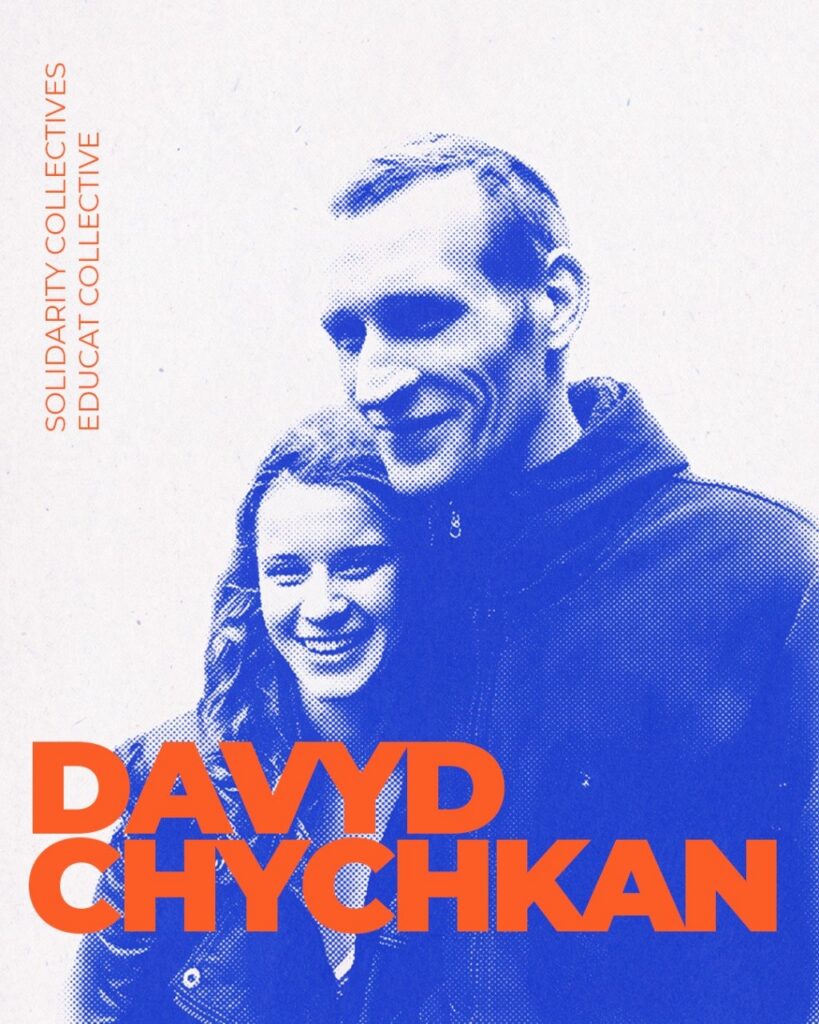
Today, Davyd Chychkan would have turned 40, but on 10 August 2025, he was killed in action.
“It is difficult to briefly describe Davyd, for he was a man of immense stature. Davyd was a man of outstanding intellect. He was not just an artist — he was an intellectual and a visionary. His artistic practice was inseparable from his social activism and was aimed at transforming society, raising political awareness and enhancing public discourse” says Hanna Tsyba, Davyd’s wife.
Davyd was an outstanding artist, social activist, friend and comrade, one of the most prominent figures in the Ukrainian anarchist movement. His loss was a painful blow to the anti-authoritarian and artistic communities, to his family and loved ones.
It is important for us to preserve his legacy — both cultural and political. To preserve it as carefully and honestly as he himself worked with the memory of the anti-authoritarians who fought, his fallen comrades, and the movement of which he was a part.
To mark this occasion, we are publishing an extensive interview with Hanna Tsyba — a conversation about who Davyd was, his role in the movement and culture, and how to preserve the memory of him and the other fallen comrades.
The interview was created as part of the Decolonising Cultures of Remembrance project.
The material was produced in partnership with Educat Collective.
Please introduce yourself.
My name is Hanna Tsyba, and I am the widow of Davyd Chychkan. He was an artist, an anarchist, and a volunteer soldier in the Armed Forces of Ukraine, serving in a mortar unit. He was killed in August 2025 while fighting in the Zaporizhzhia sector. I am also the mother of our son.
My professional work is connected to journalism, contemporary art, and visual culture. In February 2022, I was invited to join the team at the BBC’s international office. I still remember how they called me an hour before the opening of Davyd’s exhibition ‘Ribbons and Triangles’ at the Lviv Municipal Art Centre. My life has changed considerably since then, but I am still working as a BBC News journalist in Kyiv.
How would you briefly describe Davyd?
It is difficult to describe Davyd concisely, as he was an immensely important figure. Davyd was a man of outstanding intellect. He was not merely an artist — he was an intellectual and a visionary. His artistic practice was inseparable from his social activism, which aimed to transform society, raise political literacy and engage in public discourse.
At the same time, Davyd was modest and decent — people like that are rare. Out of respect for the hard work of others, he worked in one of the most challenging artistic techniques: graphic art. He devoted a great deal of time and effort to each of his pieces.
As a well-known artist, he could have avoided military service or chosen a non-combat role, as public figures often do. At the start of the invasion, Davyd, an internationally renowned artist, received numerous invitations from institutions abroad. With the help of the Ukrainian Ministry of Culture, he could easily have left the country to live and hold exhibitions in Europe, as many people in the contemporary art scene did. However, he declined this privilege in solidarity with those who did not have it and volunteered to fight on the front line with a mortar unit, alongside other anarchist fighters.
It is worth emphasising that, so far, Davyd is the only well-known artist to have fought on the front line. It seems to me that, usually, public figures are not drafted. Based on the logic of job reservations, they are evidently considered more valuable to society. However, Davyd did not accept this logic. He considered the very principle whereby one person’s life is deemed more valuable than another’s to be unjust and wrong. It was unacceptable to him that class affiliation or symbolic capital could determine the value of human life. As a man of left-wing views and simply as a decent human being, he refused to make use of his symbolic capital.
Davyd was wonderful, beautiful in every sense of the word. It was impossible not to love him. It was impossible not to admire him. Alongside all his other virtues, he had the finest sense of humour and the wittiest jokes. To me, he was like a separate planet on which I lived and continue to live. I still have the opportunity to live in the world that Davyd created. This extends beyond his work to encompass also the circles of friendship and solidarity, the vision and discourse that he shared. That is why I am not ready to speak of Davyd in the past tense. He lives on.
Tell us about Davyd’s art. What does it mean to you, and what did it mean to him?
Davyd considered art to be his congenial work*. It was his livelihood. Although he produced only conceptual work and never commercial art, he did not regard art as sacred in and of itself. Like me, he saw art more as a tool for influencing society — one that was very direct and effective, addressing the audience through images and provoking them to reflect or learn about revolutionary, avant-garde, philosophical, and social ideas.
* Reference to Hryhorii Skovoroda’s concept of ‘congenial work’ (srodna pratsia)
Although the main focus of Davyd’s works was their substance, the quality of the image was of paramount importance to him. He worked meticulously on every piece, constantly refining his technique. Davyd experimented with various media, but it was graphic art with watercolour that remained his most important medium. In his graphic art and painting, he developed a highly distinctive artistic language and aesthetic that cannot be confused with any other.
Each series of Davyd’s works is a cohesive conceptual project, often exploratory. He read extensively, both contemporary philosophers and the writings and correspondence of historical figures who interested him, particularly Ukrainian modernists. As a result, his works often offer insights into the history of Ukraine or the world, mostly linked to left-wing, anti-authoritarian movements. His narratives consistently convey ideas of solidarity, support, and collaboration. His art was conscious and inspired others to learn, read and think, just as he himself did.
For me, Davyd’s art is the universe he created: beautiful, complex and rich. While it is deeply saddening that there will be no more new works from Davyd, he created a great many projects that art historians and critics have yet to study and write about. Davyd worked tirelessly and achieved so much. There are still so many ideas and messages in his works to be explored in the future.
Davyd and I started working together almost immediately after we met. Now I continue to work with his legacy as a curator and researcher. This is partly because it gives me purpose, but also because Davyd was and remains the artist and thinker whose practice and philosophy continue to interest me most, both personally and professionally. These days, I also see his art as a form of escapism. It is the place I turn to when things become unbearable.
You’ve already mentioned the radical and political nature of Davyd’s art. The next question is about the values and principles that were important to him. Is there anything else you would like to add?
Davyd did more than profess his beliefs; he consistently acted on them and fought for them throughout his life, eventually paying the ultimate price for doing so. Davyd placed great emphasis on being an anarchist and a leftist, a political declaration that few people today would dare to make. In Ukrainian society, voicing such ideas in the public sphere is unpopular and even dangerous. Consequently, Davyd was often attacked by the far right: both physically in the street and through the vandalisation or cancellation of his exhibitions. He was subjected to violent censorship. They knew him well as a pioneer of the anti-fascist and anarchist movement in independent Ukraine, and could not forgive him for his public stance. However, Davyd refused to be intimidated and never betrayed his ideas. He defended his right to be a leftist both in Ukraine and around the world, despite the unpopular image of Ukrainian leftists in both Ukrainian society and among Western leftists and liberals who, thanks to russian propaganda, have grown accustomed to viewing all Ukrainians as radical nationalists.
Since 2014, Davyd has consistently fought a low-profile yet gruelling battle through correspondence, interviews, and public speeches. He proved to the whole world that Ukrainian leftists and socialists not only exist, but live in Ukraine, have tied their future to the country, and defend it at the cost of their own lives and health. At the same time, he demonstrated to Ukrainians, as he himself put it, that the modern Ukrainian communist is not an enemy of Ukrainian society. But it is the following of the historical Ukrainian tradition of progressive left-wing thought and a fight for justice.
Honestly, it pains me that Davyd had to emphasise this so much, as it diverted attention away from him, from his interesting, profound and extraordinary personality. While I share Davyd’s political views, I do not support sectarianism. I disapprove of his decision to remain in the shadow of the movement, the collective entity of the anarchists.
I believe Davyd was both an anarchist and a feminist due to his commitment to justice and his desire to improve the lives of the less privileged here and now. It seems to me that Davyd viewed anti-authoritarian left-wing ideas, with their call for solidarity, as a logical extension of human decency and intellectualism. However, he also valued the existence of a theoretical foundation that could be explored and debated.
Davyd loved Ukraine dearly for its non-imperial, anarchist, secular nature. He embraced Ukrainian identity and had in-depth knowledge of Ukrainian history. He greatly appreciated that Ukraine not only has a left-wing tradition, but that the very project of the Ukrainian state is, in fact, left-wing, created by Ukrainian socialists of the modern era. Likewise, he generally considered most Ukrainians to be socialists. This is not without reason, as most Ukrainians lean towards democracy and are often unwitting social democrats. Perhaps the biggest problem in our society is that Ukrainians across different generations remain largely politically illiterate and retain a paternalistic mindset as a consequence of the Soviet experience.
As an anarchist, Davyd long rejected the concept of the state. However, in practice, the existence of modern nation-states has proved to be an alternative to the new world order that emerged ‘at the end of history’, given global capitalism and the spread of transnational corporations exploiting workers, as well as new military conflicts caused by the resurgence of old imperial ambitions. Currently, only the existence of the Ukrainian state and the consolidation of our society around democratic values are halting the spread of russian imperial fascism in Europe. As a true anti-fascist, Davyd joined the Armed Forces of Ukraine to fight it.
How did you react to his decision to join the army?
I had no choice. Davyd had made up his mind. All I could do was try to delay his mobilisation. I did this under various pretexts. At some point, however, Davyd made his decision clear, and I realised how important it was to him. This decision was a continuation not only of his political path and public role, but also of his humanity. This decision defined who he was. I respect him very much for that. I could no longer dissuade him. So I tried to support him. I was certain that Davyd would definitely return. It seemed to me that his courage and integrity deserved to be rewarded. I hoped that, in time, Davyd would tire of the gruelling combat work and transfer to another post because, although he was highly motivated as a military volunteer, he had serious health problems. Unfortunately, we had so little time.
I really blame myself for letting him go. But I realise that he couldn’t have lived safely abroad, raising our child, whilst children and the elderly are dying in Ukraine and women are fighting in the trenches. However, he also found the idea of serving in non-combatant roles while his comrades were on the front line unacceptable. After all, he had spent his whole life defending justice at the cost of his own health. He was a very brave man, prepared to fight a far greater and stronger evil. As an anti-fascist, Davyd took part in street clashes with the far-right, who were always outnumbered. He was so strong that I considered him immortal. I was prepared for anything, except for the possibility that he would be gone. I still cannot come to terms with it.
How is your family coping with the loss? Do you need any support?
We’ve got a little son. Davyd loved him very much. Sadly, they were only meant to spend such a short time together. Davyd came home from the front a few times, but only for a short while. When Davyd died, Nestor was just six months old.
I truly regret that Davyd won’t be raising his child and that Nestor won’t have him in his life. I feel sorry for Davyd, who cannot see our little boy growing up. However, I understand that it is my responsibility to make sure that my son knows and loves his father. I am now doing the job of both parents.
I focus on the fact that my child needs me and that I must carry on Davyd’s work. Likewise, I really want to preserve the world he created. My parents and close friends are helping me.
You can help us by spreading Davyd’s ideas and his work. Tell the whole world about him and what he fought for. I wholeheartedly welcome all initiatives to commemorate Davyd, and all the publications and exhibitions of his work.
How has your perception of memory changed since he passed away?
I see memory quite literally as the act of remembrance. I’m terribly afraid that, over time, I might forget something about him — some detail of his appearance or the way he spoke. That’s a terrifying thought. I don’t know how to fight against time, but I intend to do my very best.
Because memory is all that remains. Memory can evoke not just a voice or an image, not just memories of individual events, but a sense of his living presence, his warmth, and our interaction with Davyd. We live in the digital age, and I have photos and videos of him. But it’s different. That’s why I’m not changing anything in our home so that I can preserve the feeling of his physical presence for as long as possible. I don’t want Davyd to become just a memory.
Davyd’s funeral turned into a kind of public anarchist demonstration in the centre of Kyiv during the war. Even after his death, he inspired people to take part in this form of political activism.
This was indeed the case. For the first time, dozens of anarchist flags flew together over Independence Square: black ones, and diagonal red-, green-, and purple-and-black. Before that, such a scene could only be found in Davyd’s paintings. It was his dream. Sadly, he managed to achieve it only at the cost of his own life. Davyd gathered hundreds of people on the Maidan, but, sadly, for such a terrible occasion.
Some people did indeed view the farewell to Davyd as a political act and came with flags and organisational symbols, including the flag of the LGBT+ Military organisation. I know that this organisation has to hold commemorations for its fallen members on Maidan in private, as displaying such flags can be dangerous. However, Davyd created a safe space for them, and on the day of his funeral, both the LGBT flag and the organisation’s flag flew on Independence Square. They didn’t ask for permission; they simply came with their flags.
It is very meaningful that there were political speeches at Davyd’s funeral, including one by our friend Lesyk, a soldier and activist who, after Davyd’s death, became the anti-authoritarian left’s most articulate public voice. Davyd had previously been that voice. He always spoke politically and articulately. He was probably the most public anarchist in Ukraine. At the same time, he was the most political artist, bringing together two communities: activists and artists. He raised the level of discourse in the art world while increasing the visibility of anarchists.
I think Davyd would have been pleased that his funeral turned into a political event. He would have appreciated the aesthetics. It’s a shame he couldn’t see how it turned out.
Do you think there is a risk that the stories of the anarchists’ involvement in the war will be erased or distorted?
No, as long as there are other anarchists to preserve the memory of those who have fallen. Above all, anarchism is the responsibility of anarchists. Besides, despite its international nature, anarchism is not a mass movement, so many people in the movement know one another personally, as well as their historical figures. It is a close-knit community that preserves the memories of its heroes and their names from generation to generation.
Davyd, for example, would sometimes watch archive footage of Peter Kropotkin’s funeral. For this ceremony, the Bolsheviks released from prison over thirty thousand anarchists and Socialist Revolutionaries, purely for the sake of creating a good impression on Western delegations. At the end of that day, all these people were arrested again and later executed. That is why Davyd once even cried whilst watching this footage.
The more difficult question is how to make these stories visible to the wider public. I see this as a challenge. However, this memory will be preserved for centuries within the anarchist community and the broader progressive left. I am certain that Davyd and his comrades, who fought and died, will be seen as heroes by future generations of anarchists in Ukraine and around the world.
But how can we make these stories more visible to the broader public?
Davyd worked tirelessly to raise awareness among Ukrainians and the rest of the world about the involvement of Ukrainian anarchists and anti-authoritarian leftists in the war. In particular, he created a series of portraits of these people, dedicating one to each comrade who had already been killed. He worked on the series from 2022 until his mobilisation in 2024. Davyd put his heart and soul into each of these large-scale graphic artworks. This project was significant to him, as it celebrated the beauty of our heroic comrades. Entitled ‘With Ribbons and Flags’, this series of portraits was due to be presented in its entirety at the Odessa Art Museum in 2024. However, to appease the so-called “activists” from the organisation “Tradition and Order”, the museum cancelled Davyd’s exhibition. I still cannot believe it, that during the war, a national museum refused to display portraits of serving military personnel and fallen heroes simply because they hold left-wing political views. As one right-wing guy involved in the social media campaign to shut down the exhibition put it, ‘Who cares about dead lefties?’ Davyd was used to constant harassment from the far right. In 2017, they physically attacked his exhibition in Kyiv and destroyed his work. But the act of censorship at the museum during the war was particularly painful for him, as the museum refused to display portraits of people he considered heroes. In doing so, the museum also devalued all his work over the past two years. So Davyd decided not to continue, and even painted the sky black in the group portrait of his fallen comrades, to which he had been adding new faces for two years, as if it were an iconostasis. As it turned out, this was to be Davyd’s final work, and the painting should now include his own face.
Following Davyd’s death, it became clear that no one would be able to celebrate and portray the anti-authoritarian leftists and anarchists within the military quite as he did. Furthermore, it seemed that only Davyd had kept a record of fallen comrades. To some extent, I have taken up his cause, as he is now among the fallen, and I live on in an attempt to create places to commemorate him. I am grateful to Davyd’s comrades and the Solidarity Collectives for supporting me. Together, we took simple steps: we placed diagonal flags at an impromptu memorial site on Independence Square, and planted trees in the places where Davyd and his comrades used to walk. We also planted trees where others had already been planted in honour of the first fallen comrades. Although these actions may seem simple and perhaps even trivial, they were important to carry out, as they constituted a sincere and therapeutic collective practice. I believe this practice will continue, as we can already see its results: places of commemoration for our fallen comrades have emerged in the city. I find it rather positive that these places are set amidst nature and are not official because they are located at the crossroads of our everyday paths, amidst life, rather than being isolated in a sculptural ghetto.
Of course, it would be wonderful to create a memorial square in Kyiv or another Ukrainian city dedicated to the fallen anarchists — one that is officially named as such and marked on maps. But I fear that our society, which so readily accepted the cancellation of the exhibition of their portraits, is not yet ready for this. I believe that naming a square is the duty of the living, particularly civilians. While the defenders fight imperial invaders, we must fight for their interests, for their representation, and to ensure their names are inscribed in the history of the Ukrainian struggle against russian fascism. We must fight to secure a place for our fallen comrades in the pantheon of Ukrainian heroes and to have their political convictions recognised. Otherwise, without these details and personalisation, the names of today’s heroes will, eventually, become empty symbols for future generations.
What would you like people to understand about his legacy and this loss?
Nothing can ever fill the void left by his loss, in either the artistic or political spheres. He was one of a kind. He played a vital role in our society. He was a guiding light and a pioneer. This was recognised by everyone when he passed away.
Davyd and the other defenders made a choice that modern society would find impossible. After all, people in modern, consumerist, individualistic societies are primarily drawn to comfort and pleasure. Yet Davyd and the others gave up their personal lives, interests, careers and futures. They gave up domestic comforts and their freedom, instead accepting a lifetime of servitude consisting of physically exhausting and psychologically devastating daily labour from which there is no escape, despite burnout in every sense of the word. They are sacrificing their health — and, with it, the most precious thing a person has — their one and only life.
When you look at most people in neighbouring countries, it becomes abundantly clear just how impossible this choice is. They are not even prepared to contemplate the prospect of the war escalating, as that would force them out of their comfort zone. Not everyone in Ukraine is ready to make this choice, either. I am not ready for it yet.
However, Davyd lived his life in such a way that this was an obvious choice to him. He lived a political and principled life, consistently following his beliefs and values. He was a passionate man, even beyond his youth. He always chose to fight: against injustice and oppression; for a better society; for equal rights; for the vulnerable; for the ideals he shared; for historical truth; and for the perfection of artistic expression. That is why he sacrificed his life in the struggle against russian imperial fascism and post-truth politics, fighting for Ukrainian democracy, our free society, our social constitution, a modern left-wing Ukrainian state project, and a progressive, politically articulated future for Ukraine, which he visualised and dreamed of.
Davyd once told me that he finds people who lived at the turn of the nineteenth and twentieth centuries more interesting than his contemporaries because modern people are so concerned with their appearance, what they consume and how special they are. Back then, people generally looked the same but differed in their ideological convictions and their affiliations with various political movements. Davyd was fascinated by the political literacy of people in the modern era. With great enthusiasm, he researched the writings and correspondence of Ukrainian left-wing intellectuals of the time, including Lesia Ukrainka, Ivan Franko, and Mykhailo Drahomanov. Through his work, he initiated a timeless dialogue with these figures. Davyd himself was a man of that era, when people were passionate about ideas and ideals, and willing to sacrifice their lives for the cause. Davyd was a revolutionary and died as a revolutionary.