Fifth Birthday In Captivity
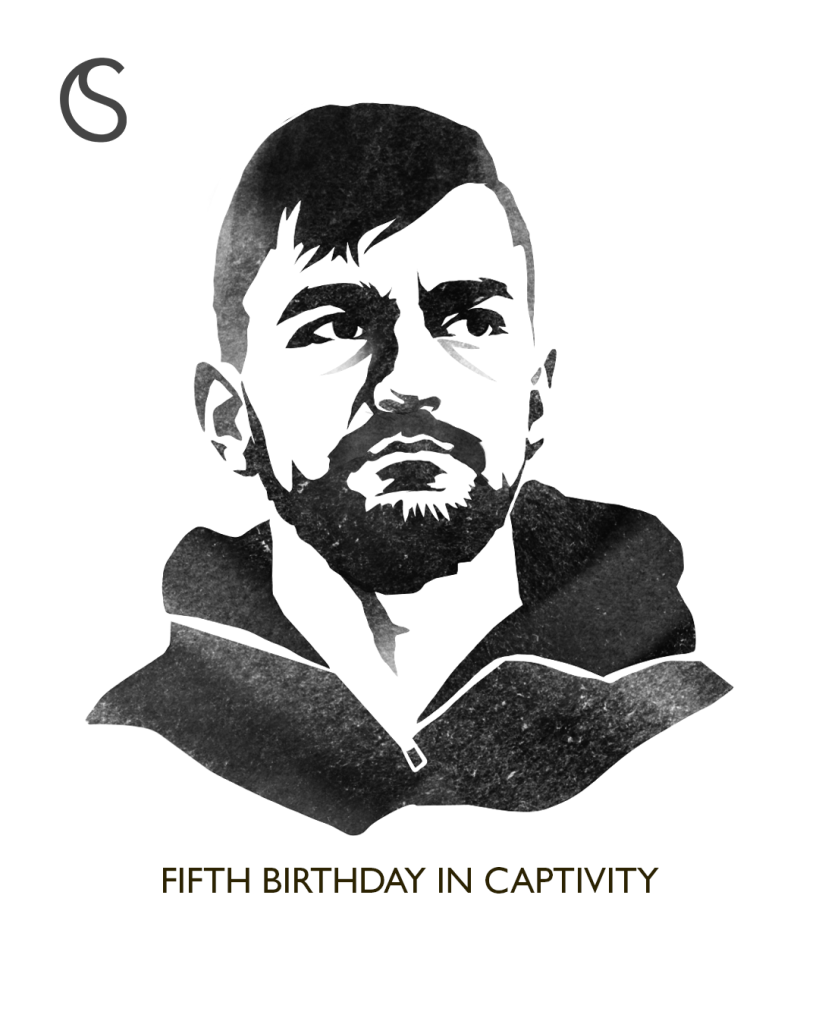
On 1 November, Denys Matsola turns 39.
This is the fifth birthday he will spend in Russian captivity.
For the past 3.5 years, Denys has been held in solitary confinement in a prison in Kineshma.
Ahead of Denys’s birthday, we spoke with his comrade Iskra. Iskra is a former prisoner of war who went through a similar ordeal in captivity and was the last person known to us to have seen Denys while he was in captivity.
In this interview, Iskra talks about Denys, his own experience of captivity, and life in Russian prisons.
My name is Vladyslav Zhuravlov. My call sign is Iskra. I am an activist and a marine in the Ukrainian Armed Forces. While defending Mariupol in 2022, I was taken prisoner. I was recently released after spending more than four years in captivity.
How did you meet Denys, and what connects you?
We met whilst we were both involved in activism in Lviv. Even after our organisation dissolved, we remained on very good terms as comrades and remained close friends. At one point, Denys couldn’t find a way to help society as a civilian, so he decided to go to the front line, where I was able to welcome him and organise his service.
He completed his training and arrived at the front on 1 January 2022, and there he encountered Russia’s full-scale invasion.
At first, we held our defences near the village of Shyrokyne, and then, to avoid being surrounded, we had to withdraw to Mariupol, where it was easier to hold our defences. When we had run out of resources or were left with extremely limited supplies, our command, primarily Lieutenant Bezsmertnyi, organised our surrender under the guise of a ‘green corridor’. Denys, who had been wounded and was at a different location, was told that we were suffering very heavy losses and that everyone capable of bearing arms had to be at their posts alongside their comrades. He agreed to come to our position and support us. We had indeed suffered very heavy losses, but Denys was not taken to our positions; instead, he was taken to a Russian checkpoint and simply handed over as a prisoner. When he boarded that bus, he was convinced he was going to help his comrades, but they took him nowhere near where he expected to go.
We talked about this whilst we were already in captivity, as we met on 4 April 2022 in Sartana. It was a barracks with barred windows, where we were held on the first day. From there, the FPS* special forces transported us to Olenivka, where our entire battalion was being held. We stayed there together, in the same barracks, until 16 April. From there, they took us to Taganrog. I know that Denys was also in the vehicles heading for the prison in Taganrog. However, we didn’t see each other again. The last time we met was on 16 April 2022.
*Russian Federal Penitentiary Service
What helped you stay in touch with life outside captivity?
It’s hard to say definitively what exactly kept me going. Of course, my ideology sustained me throughout, because I’m an idealist. I was fully aware that I hadn’t ended up here by chance; it was a natural course of events, and it happened because it was likely to happen. As a professional military, I also knew that this was one of the risks of my profession. Firstly, I accepted it as given. Secondly, of course, I was greatly sustained by my belief in a better life upon my return, and love for my wife. Thirdly, as I spent quite a lot of time there, my motivation to hold on varied at different times.
At first, I just believed that it would all be over soon and that I just had to hang in there. Then there came a moment when I realised that we had already been locked up for a long time, and so it couldn’t be long now. After that, I gave up on my expectations; I stopped waiting for the [prisoner] exchange altogether.
To put it bluntly, I switched from survival mode to ‘living mode’. In other words, I came to terms with the fact that this is my life, this is how I live, this is my reality, and it’s not temporary but permanent. Yes, the exchange will happen one day, but you don’t get a sense of exactly when it will be; you just know that it will happen. It’s like how people know they’ll die one day, but they don’t dwell on it. You simply start looking forward to something more tangible and more accessible. You wait for the moment when it’s your turn to get a book, the moment when it’s time for your next meal, the moment when lights out. You wait for the ordinary, everyday things that bring you at least some pleasure in this new life. That’s it.
You’re not even holding on anymore, really; you’re simply existing in this state because you’ve got used to it. And the worst thing about all this is that once you get used to such conditions, you no longer even feel that you really want to go back. It’s as if you do want to, but it’s such an abstract desire. It’s like, for example, I might want to go to Disneyland, but I’ve never been there, and it’s hard to imagine what it’s actually like.
Over time, waiting for the prisoner exchange becomes just the same. You realise by now that people have changed, that everything there has changed. You don’t know for sure whether they’re expecting you, what your status is, or whether everything will turn out all right for you in the end. But here, it feels as though you’ve already got used to all of this. Everything is stable. Of course, you always want to go back, but it doesn’t feel like a necessity anymore.
During your time there, did occasions such as New Year’s Eve or birthdays carry a sense of optimism, or, on the contrary, were they rather gloomy? How were they perceived?
I wouldn’t say they were gloomy. Firstly, people tend to get nostalgic, for example, on New Year’s Eve. Everyone starts talking about how they celebrated, what they had, and everyone lives in these little bubbles, like in a comic strip, where it’s all visualised. That’s one thing. And secondly, obviously, it isn’t officially celebrated at all, because we’re not supposed to know what the date is. We keep track of the days ourselves, even though we’re not allowed to do so.
As for birthdays, some prison cells had their own traditions. In our cell, for example, everyone would chip in a spoonful of porridge for whoever had a birthday. The total portion was about seven spoons of porridge, so if there were ten of you in the cell, you’d get nine extra spoons of porridge. That’s more than the standard portion if you count yours in, and you’d be well fed for the whole morning. You’re in a good mood because you’re not hungry in the morning, unlike how everyone is usually underfed in prison. These were the pleasant moments. It’s a sort of general cell tradition, and on top of that, someone might give you a little something extra, something unexpected. For example, they might share some bread and kissel, or give you a cutlet if it’s on the menu that day.
What do you think we can do to support Denys and the other prisoners of war? What would you like to say to Denys on his birthday?
I think we need to speak out, raise awareness and not forget that Denys has no family in the territory controlled by Ukraine. We are his family. That is, his revolutionary circle, his comrades. I believe it is our responsibility to bring him home. We must do everything we can to speed up the process. That means we need to talk about a prisoner exchange and take action to make it happen. We must closely monitor the situation.
My wish, I think, is quite clear. I want Den to return. I want this exchange to be his birthday present. That would probably be the best present of his life. I don’t really know what else to add.