Toxic pacifism: interview with Mira
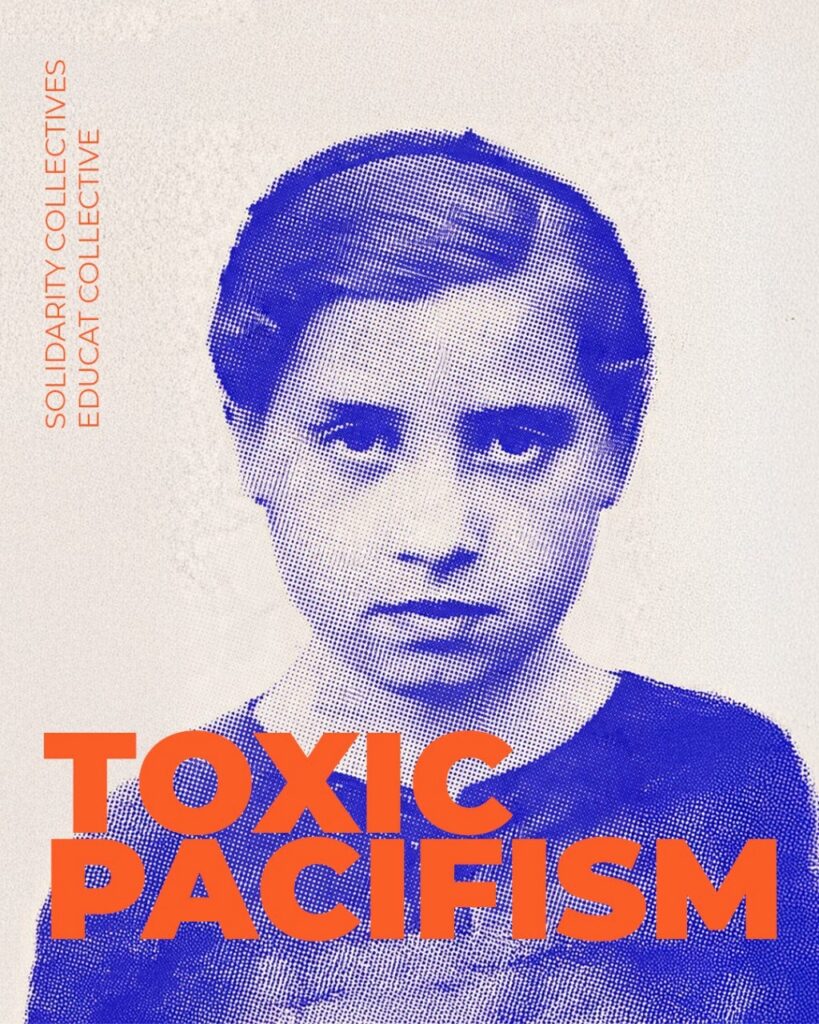
As part of the Decolonising Cultures of Remembrance project, we are launching a series of interviews and articles with anti-authoritarian activists on colonialism, culture of remembrance for fallen comrades, wartime activism, and international cooperation. Against the backdrop of full-scale war in Ukraine, we are attempting to reflect on current events from the perspective of building a sustainable culture of remembrance. Our first publication is an interview with Mira, an activist from Solidarity Collectives, who organises international events and shares the experience of anti-authoritarian resistance.This material has been produced in partnership with Educat Collective.
Let’s start with a question: who are you, and how would you describe yourself? What role do you play in Solidarity Collectives?
My name is Mira, and I am from ABC Kyiv and Solidarity Collectives, organiser of Good Night Macho Pride festival, which is currently on hold but will hopefully be revived in the future.
I work in the media department in Solidarity Collectives. I organise events with comrades in different countries and facilitate discussions, negotiate support for our collective, sell merch and collect donations. I also explain to those who do not understand or sometimes even disagree why we are determined to support Ukraine in this war. I explain what motivates our comrades who are fighting and why everyone striving for democratic improvements — leftists, anarchists, antiauthoritarians — why all these people need to support Ukraine now.
How many events have you had over the years, give or take?
Over 200, I don’t know exactly how many.
Is there a pattern in how people who come to your talks think about Ukraine? Do people come with a lot of empathy or with conservative propaganda narratives, for example? Is there a common pattern?
Most people have no knowledge about Ukraine or this war. Many of them are young, live far away and have heard something, but you can’t say that they really know anything. There are people who have been supporting us very strongly all these years. They organise these events in support of Ukraine themselves, and even talk about us in some countries. Then there are people who are in the minority — like in a room of 50 people, there are usually no more than two of them who simply repeat russian propaganda and, unfortunately, believe it wholeheartedly. They usually start their sentences with “I don’t support Putin, but…”.
And after ‘but’ the gates of hell open. I think russian propaganda differs in different countries, so whataboutism differs too. Another classic criticism: ‘Anarchists shouldn’t be in the army!’ I tell them that there are exceptions, and historically we are not the first, and we are certainly not the last. But some people don’t want to see the real circumstances and think in a very sectarian way, as if they were anarchists in a vacuum. For them, there are rules that cannot be broken, even if the world turns upside down.
There are people who ask about nationalists, but, actually, this has decreased significantly over the last year. I think they have finally realised that very different people are fighting. Yes, there are nationalists, but there are many other people too.
There are people who ask about this marginal collective Assembly. It is very small and does not do any work in Ukraine. Clearly, this is not a real collective working ‘on the ground’ because there is no information about what people are doing in Ukraine. There is only their endless opinion [essays].
I believe that if an anarchist collective does nothing, it is a fake. If it is a collective, it has to do some work. If they are anarchists, they have to take action. And if they do not act, but only express ‘opinions’… What can be said about them then?
People ask about them because it was important for the ‘anti-militarists’ to find at least some group that would echo their views. If you go to Greece, Italy, or Spain, people there ask about May 2* — this is probably a favourite topic among local ‘pacifists’. In their opinion, trade unionists were killed for belonging to a union, which is complete nonsense.
*The clashes of 2 May that took place in the city of Odessa on 2 May 2014.
They also claim that the people of Donbas want emancipation, which is far from the truth. They repeat all these outdated clichés. Stereotypes are rife there; they might spray paint “Z” graffiti on the entrance to an event — anything could happen. So it really depends on the country. But I would say that this is less of an issue now. We were of more interest to them in the first year.
Now they are trying harder to organise their own events and promote the whole idea that Europe is becoming militarised. They argue that we need to prevent the militarisation of Europe and disarm immediately. I think they have also realised that shouting at me and behaving like brutes does not earn them acceptance in the local community, which is not beneficial for them. That’s why they changed their strategy to become more appealing to the locals.
Would you describe that as toxic pacifism?
Wow, that’s a good way to put it! Well, there’s this pattern where a man yells at me. It’s usually a white guy over forty. While society demands tolerance on many other issues, these people feel like they can say whatever they want [at the events]. Again, it depends on the country, but in many places, ‘pacifists’ blamed Ukrainians themselves for the war. Many people sit back and watch calmly, even though they would be angered by such victim blaming in other situations.
Is there such a thing as reasonable pacifism? Is there a pacifist stance that shows solidarity with Ukraine?
I consider myself a radical anti-militarist. I am against war, I do not like war. I think we here know what it means to hate the war much better than all those people who call themselves anti-militarists in Europe. We are the real anti-militarists: we want the war to end. That is why some of our comrades joined the military — to make russia leave this land and end the war.
It really depends on interpretation of pacifism and anti-militarism. If we take pacifism in its classical sense, then I don’t really understand what purpose it serves for anarchists. Sorry, but you can’t get justice just by asking nicely. It’s not just about war, it’s about everything in life.
To what extent do you think the Western anarchist audience and movement reproduce imperialist thinking in campism rather than colonial logic itself? In other words, do they lack a reflective, decolonial view of the world?
I think Donald Trump is making it easier for them to believe that ‘everything is not so clear-cut’ :). In 2022, the main accusation against us was that we were essentially NATO. Now they have stopped talking about it and are coming up with new arguments. But again, it depends very much on the country. I don’t know why, in the Netherlands, for example, I didn’t encounter people viewing things in black and white, refusing to help or badmouthing us. But then you take a train to the French-speaking part of Belgium, and there you see a different picture, more indifference and aggression. It’s interesting how this relates to language and which languages russian propaganda was translated into. I think that’s where the problem lies. Though, I can’t say that I know exactly how it works.
There are countries where it is very difficult to overcome this duality. That is why we have a strange situation where they understand that the occupation of Gaza is bad, yet the occupation of Luhansk does not seem so bad to them for some reason. Unfortunately, even on the left, there is a tendency to see us as one people.
For example, almost every time locals host me in Germany, some German comrade tells me about the good russians he knows. I also know russians who are pretty decent. I just don’t understand why they are so eager to share this information. They wouldn’t tell a Kurd about good Turks or a Palestinian about good Israelis at the first opportunity. Why are they treating us this way?
I think the problem is that we often seem like some kind of Eastern people who have quarrelled for some reason. They almost never know our history. For example, a lot has been said about the Palestinian-Israeli conflict, and it has been relevant issue for the for many years. It’s a little easier with the Kurds because they don’t have a state, so they don’t seem to sympathise with the state, although there have been many similar issues on their side, both about NATO and nationalism. But with us, it’s a strange thing that they know nothing about this conflict, about the history of Ukraine and the related history of russia. Yet the common perception is that we have somehow quarrelled and need to be reconciled.
A marginalised opinion…
We organised an event with our comrades in Germany, who who support us and regularly deliver humanitarian aid. I had a conversation with these comrades, who are ‘on our side,’ and they said, ‘The only thing that is probably difficult for us is nationalism among large segments of the Ukrainian population.’ I asked, ‘What exactly do you mean by nationalism right now?’ They replied, ‘Well, it’s hatred towards russians.’ I told them that my grandmother had been taken to a labour camp during World War II and forced to work as a slave in Germany for four years. Even on her deathbed, I think she still hated them — she never got rid of that feeling.
I asked them, ‘Do you consider my grandmother a nationalist because she hated Germans?’ And they replied, ‘No, it’s the hatred of the oppressed.’ I said, ‘Okay, how is that different from Ukrainians hating russians today?’ To which they reply, ‘Oh, well, that may be different!’
It’s strange because they don’t make that association. It’s as if they can’t make this connection, even though the situation is very similar. My grandmother also survived the Holodomor and was forced to work in Poland by the Bolsheviks, right after her time in a German camp. I don’t think she liked Russians very much either.
Tell us how much your family remembers about World War II and the Holodomor, how these experiences have shaped your life and that of your family?
My grandmother told me a lot.
I never met any of those [relatives] who fought in the war. Unfortunately, they died early. One grandfather died from the complications following his injuries in World War II, many years later, after turning fifty. But those complications were still the result of the injuries he sustained before his capture and the poor medical care in the concentration camp — which, of course, was almost non-existent.
Another grandfather died of cancer less than a year after the Chernobyl disaster, which, in principle, is also part of the colonial experience for me.People in Ukraine did not know for many days that the disaster had happened, and they could not leave or do anything to reduce the damage that Chernobyl had caused to their health. Overall, it is very difficult to count [the victims] because lots of people who died in Ukraine in the years following the Chernobyl disaster are not generally considered victims of Chernobyl.
Apart from my grandmother’s stories, there are other mementos, such as a letter from the camp — she managed to bribe German policeman to send a letter to her mother. I have this postcard and a photograph from the camp. Hardly anyone has items like these, because there was usually strict censorship made it impossible to pass on such things. On my mother’s side, I also have a well-preserved history of the Second World War, and a little about the First World War. I have letters, casualty notifications and photos.
So, did your family hold some animosity towards the Soviet Union?
My family hated the occupiers.
Do you mean the Germans?
All occupiers. Russians were also not very well received because of the Holodomor. Or because of the dekulakization. There were many reasons to dislike them. The problem here is that it was very easy for families who wanted to preserve mementos of World War II. But other things… It wasn’t so easy. It was risky or deemed dishonourable.
My great-grandmother, for example, had a brother who enlisted as a volunteer and was killed. I’ve heard about him my whole life: Anatoliy, this and that, but no one knew where his grave was. Now I have found out where it is — in Crimea. But I can’t go there because of the new occupation of the peninsula. I think it would be great if someone finally visited Anatoliy’s grave. Almost 100 years have passed; it would be a nice gesture. Unfortunately, another invader now occupies the land.
There was also a brother who was a draft dodger and was ‘busified’. When ‘vatniks’ glorify World War II and say, ‘Oh, but now there’s busification,’ they simply don’t really understand what ‘busification’ was really like back then. I didn’t know about him because it was considered dishonourable to admit that someone didn’t want to defend their homeland and tried to escape. In the end, his family, whom he had taken from Kyiv to Kharkiv to escape the war and mobilisation, found themselves in a very difficult situation. During the occupation of Ukraine in World War II, Kharkiv was worse off than Kyiv, and his younger daughter died. No one talked about him. I only found his letters when I was an adult. They hadn’t been destroyed; it was just a topic people didn’t discuss.
Not everyone in the West knows this, but people who survived captivity had to go through NKVD filtration camps when they returned to the Soviet Union. This is the same process that Russia is currently carrying out in occupied territories. You are put in front of a military officer and have to prove that you are not a ‘traitor’. That is, that you were not too compliant or cooperative with the administration in the concentration camp. When we talk about the history of the Holocaust in Europe, no one did the same investigations there. But they did in the Soviet Union.
Then, my grandpa was in a concentration camp, but he got through the filtration and went on to fight in the East. He continued to fight in World War II until 1946. As for my great-grandfather, I can’t know for sure, but it seems that he failed the filtration process. Even his granddaughter, my mother, didn’t know that he had fought in the war. He said that he was blind and didn’t fight, but we found his military ID. He was in a concentration camp from July 1941 to May 1945. Something must have happened that forced him to hide his military service.
Perhaps this has been researched less in other families, but if you dig deeper, you will find that everyone has relatives who did not pass the filtration process, or who did not want to fight. They were either imprisoned or forced to fight. But these are not the stories that live on. After the war, everyone wants to forget everything, and if there is anything to be proud of, it is heroes. If a person is not a hero, then they can be forgotten.
What other similarities do you think exist between Soviet methods and those currently being used by russia in the war?
Besides filtration? Abusing people. I would argue that there are parallels with how the Soviet Union behaved when it occupied Europe and other territories. However, there are also similarities with the Germans, because my grandmother, for example, was simply kidnapped from her home at the age of 14. They forcibly took her away to work in Germany. Now russia is also kidnapping children, and we can only guess what they are doing to them there.
At the same time, russia actively exploits the image of the ‘Great Patriotic War’ as the only positive force that participated [in that war], using this narrative to justify its war against Ukraine. However, it is surprising that we, as activists and Ukrainians, do not attempt to challenge this narrative and assert our own legitimate participation in World War II. Is it because we want to distance ourselves?
I think it would be difficult for us to claim our victory over the Nazis, among other things, because russia is very active in this field. Unfortunately, this is the result of colonisation. They use this part of history to their advantage. Many people in the West perceive the USSR as russia, and russia takes credit for all the joint victories and achievements of other nations, presenting them as their own.
And the world falls for it. It’s important to explain all this, but it’s difficult because here [in Ukraine] so much has been going on for so many years of occupation. In general, before the war started and at the beginning, people said, ‘Oh my God, Germany can’t help Ukraine because they can’t risk bombing russia again’. Although they never occupied russia entirely, only a small part of it. They occupied Ukraine and Belarus twice, the second time it was the whole country. On maps from the First World War, a large part of Ukraine is also occupied. Also by the Germans. They don’t feel any guilt towards us, but they do towards Moscow, even though they never occupied it on such a large scale. They view us through a historical lens as russians and are not interested in our opinion because they do not recognize our agency.
That’s how it is with World War II. When listing those murdered by Nazi Germany during the war, they say: Jews, Roma, gays and communists. They almost always forget to mention the Slavs. It wasn’t Russians who were killed; it was Slavs, ‘untermenschen’. For example, Slovenians, because they are also Slavs. They just live a little further away, so they are not remembered either. That’s just how it goes.
Do you think that the experience of World War II influenced the participation of Ukrainian anarchists and anti-authoritarians in this war, who most likely had traumatic memories of this experience in their family history?
I am sure of it, even if people don’t realise it. Throughout our history, we have been occupied and attacked, and have had to defend ourselves. So, when we were invaded again, many people knew how to respond.
When I woke up to the first explosions, one of my first thoughts was: ‘What did my grandmother say? What did they do there at first, when it all started?’ But she didn’t say anything; she just kept talking about the camp. Well, too bad.
I mean, why didn’t she give me any practical advice about what to do? Looking back, I realise it’s pretty strange to hold that against my grandmother. She was hoping that ‘never again’ really meant never again, as we were always told. Although, she was very frightened — she kept drying bread on the balcony for the rest of her life, just in case there was a famine or war. So, 60–70 years have passed, but this trauma never left her, even though she experienced it at a young age while growing up in the camp.
So I think it does have an impact. For example, I recently had someone from France at my event who told me all sorts of things. He said that France has such a strong tradition of pacifism that many of the leftists there didn’t even participate in World War II and fled instead. I was so shocked to hear this, because one of my great-grandfathers tried to flee, and it’s considered shameful, so no one talks about it. But for them, it’s like, oh, the leftists who fled so they wouldn’t have to fight the fascists — which meant that our great-grandfathers, grandfathers, and some of our grandmothers had to fight, because they didn’t have the opportunity or privilege to flee the war. Some people are proud of that [defeatism]. I find that odd.
We know that, for our older generations, occupation was an existential threat that wanted them dead. We also understand now that any occupation poses an existential threat: the occupiers will come and kill you, they don’t give a shit about you. Because they are already invaders who have already done such terrible things as coming into people’s homes and taking everything they have — their homes, their land. It is incomprehensible to simply rob a person of everything. It is clear to us that this is evil and it will spread until someone stops it. If it is not stopped, the invaders and fascists will prevail. C’est la vie.
And for that French guy, it might seem that Nazis just came and killed Jews, but basically, everyone lived a normal life. I know stories about some French people who had relatives in the resistance, but his probably ran away. So now he thinks,“If anything happens, I’ll run away too. It’s no big deal.’ But we don’t have that option, because no one ‘ran away’. Maybe some civilians left, but all those liable for military service stayed and fought. More people probably ran away during the current war. Because now it’s possible, but back then it wasn’t.
Looking at World War II, the memory of people who died in that war, like relatives, is fading a bit. How important and how possible is it to ensure that the memory of anarchists who died in this war isn’t forgotten? How relevant do you think this tendency to forget will be?
It is always relevant, sooner or later, everyone will be forgotten. That’s right, it can’t last forever. World War II is still okay, but Napoleonic Wars have been completely forgotten. Our relatives probably took part in it too, but we don’t know about it, do we?
But, for example, in my family, my great-grandmother’s kept all of her brother’s letters and the casualty notification. I feel it’s important that I have something tangible; it makes this story very real. I think the problem is that everything is forgotten due to the lack of mementos. For this reason, I believe that the politics of remembrance is very important. It is crucial to preserve not only the story of the person, but also the writings of the comrades who lost their lives, if there are any memories of them, and there are always memories — their mementos, their photographs.
For example, I find it very symbolic that we cannot show the faces or names of our Belarusian comrades who have been killed. This is because it would pose a great threat to their families as long as Lukashenko’s regime remains in power. The regime may take revenge on their mothers or other relatives. This has already happened, which is why we have this policy.
This is very important, and I think that this is one of those symbols that if we win, we will be able to name them and show their faces. It is essential to preserve all these things, and it is very good that there is a lot of material about some people. For example, there is a memorial website about Dmitry Petrov: there are videos with him, there are books. I hope that there will be a lot of material about other comrades as well. I heard that there will be a documentary film about David Chichkan. There is a video of him reading poetry. Perhaps it is time for us to create an archive. We can print out photos and texts and collect and preserve them. It would be good if we could eventually create websites and collect the footage.
For example, I organised an event for SolCol in Montpellier, France. They had Durruti’s correspondence with a guy who lived in Montpellier. That’s how they started their archive, which is really cool. And, by the way, my speech and the stories about our comrades on the frontline was added to the archive in Montpellier.
We also planted trees, but they are in such a delicate state. We need some kind of official place, maybe a small park with trees. In Switzerland, there is a whole forest of such trees, with photos and tags with names hanging on them. There are already some for our comrades — for Marsi, Finbar, Cooper and Dima. There is a place in a world, this park, where anarchists are commemorated — those who died in Kurdistan, those who died here, Makhnovtsi and others. Well, I don’t know for sure about the Makhnovtsi, but there were some historical figures there. Tangible and intangible means of commemoration are very important.
I think it’s critical that they don’t become knights in shining armour. They should remain [in our memory] as comrades with their strengths and weaknesses. That is, who they were. More or less.
Do you have any final thoughts?
I think that anarchists, and the anarchist movement in general, often advocate for the freedom and liberation of people and nations, so that everyone can be free, happy, and equal. But those who live in imperialist countries have less experience of collective oppression. They should reflect on this and recognise that their only access to it is through us or other people in colonised countries.
Unfortunately — or, in a sense, fortunately — we have the experience of past generations, their oppression, and their struggle for their rights. We have our share of war, oppression, and loss. It’s a really tough experience these days. But I think the best we can do is to ensure that this struggle is not in vain.
Part of this is the culture of remembrance, because by remembering these people, we remember their journey, their sorrows, their hardships, and their courage to rise up against oppression and fight. I think the meaning of the culture of remembrance is not in death, but in remembering people’s lives.
It would be most beneficial for our Western comrades to learn from our experiences of oppression and liberation, participate in them and build their own experiences on real examples rather than being armchair critics or turning a blind eye.
Given this, I do not quite understand how one can call oneself either anarchist or anti-fascist, say ‘never again’ — and yet fail to see the fascist invasion and heroic anti-fascist resistance that is currently taking place in Ukraine. How can one refuse to get involved?