Ceasefire : life in the temporarily occupied territories
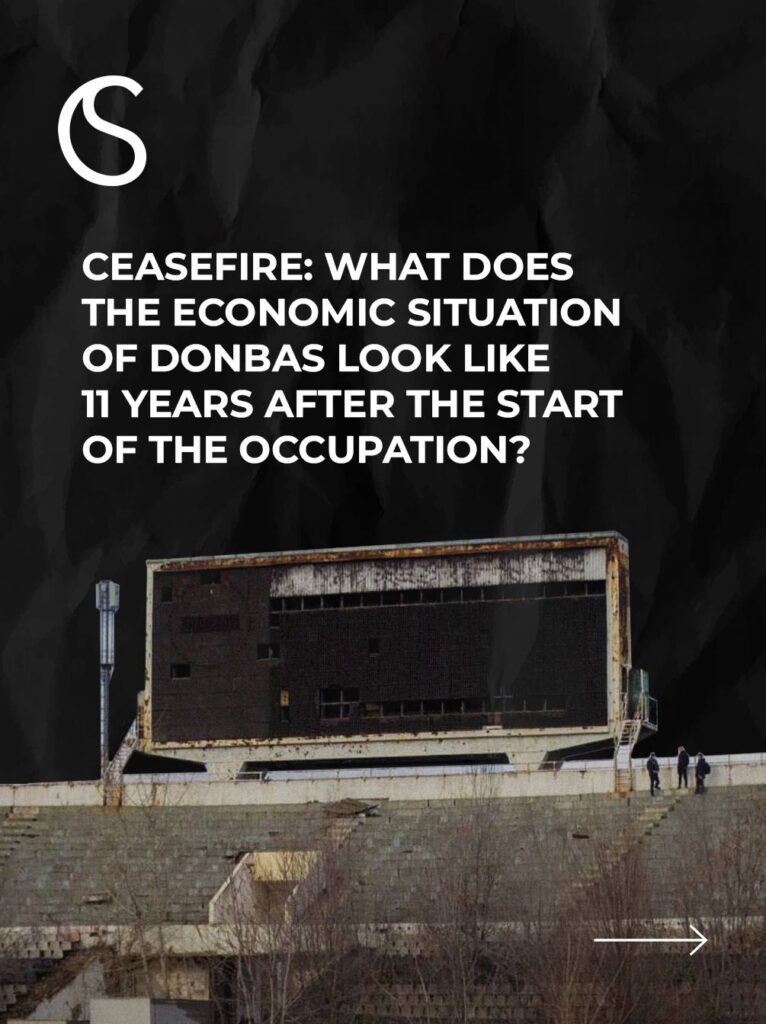
Ceasefire: What does the economic situation in Donbas* look like eleven years after the start of the occupation?
Over more than ten years of occupation, the region has seen neither an economic miracle nor even a reduction of the stagnation that began back in the turbulent 1990s. But is modern Donbas truly a “second-rate territory” even within russia itself?
Life in the occupied territories is marked by constant shortages, the search for income, and dependence on the decisions of the occupation administration, whose statements conceal deep social inequality and economic decline. Under such conditions, a space of forced survival is formed — where people persevere not thanks to the system, but in spite of it.
Important: Under occupation and control of all local media, it is almost impossible to obtain objective data. Most figures cited in this text are the result of calculations based on open sources, local Telegram channels, and statements by official representatives of local authorities.
*Donbas — a historical, cultural, and economic region in eastern Ukraine. The word formed from Donets (Coal) Basin, referring to the Siverskyi Donets river and Donets Ridge.
Administratively, it encompasses parts of the Donetsk, Luhansk, and sometimes Dnipropetrovsk (Pavlohrad district) regions that lie within the Donetsk coal basin.
Socio-economic situation
In Donetsk and Luhansk regions, local wages are significantly lower than those of russians who arrive to work in the occupied territories.*
*This difference is mostly due to job requirements found in a large percentage of professional vacancies, including: possession of all necessary russian documents, including a passport, and 1 to 5 years of experience working in russian companies.
What seemed like high earnings at the start of the occupation is now often insufficient for a normal urban life.
Currently, the average salary is around 27,000 rubles in Donetsk and 55,000 rubles in Luhansk. The official subsistence minimum is 16,669 rubles.
The highest salaries are given to military personnel and “officials” of the occupation administrations and other collaborating structures, as well as construction workers.
Above-average wages are also offered to medical staff due to a severe shortage of specialists. However, even with higher pay, vacancies remain unfilled, and obtaining qualified medical care and medicines in cities is becoming increasingly difficult.
Rental prices vary by locality; for example, long-term housing offers in Donetsk start at 15,000 rubles.
This summer, utility tariffs were increased so that “residents of the DNR get used to living by russian standards.”*
*Direct quote from the newspaper Komsomolskaya Pravda.
Electricity is supplied with “scheduled outages.” Water supply suffers from significant disruptions.
In spring, russian media reported that since the beginning of the year, more than forty enterprises in the region had stopped paying wages, including the “Voda Donbasa” water utility.
According to locals, one person with their own housing needs at least 35,000 rubles a month, while a comfortable life starts at 70,000–80,000 rubles, depending on the city and excluding expenses for children.
Since the beginning of the year, a new russian taxation system has come into effect, increasing taxes threefold for residents of the occupied territories.
Prices for some food items are higher than in moscow, service costs are rising, wages are lagging behind, and deteriorating infrastructure is not being systematically maintained. Due to inflated prices, locals often travel to neighboring russian regions for meat, fish, and other products. Clothing is ordered from Chinese suppliers through russian online stores, as it is significantly cheaper than local market prices.
Mobile communications and internet remain expensive and low-quality — local providers still rely on old Ukrainian network equipment or temporary russian solutions.
Public transport runs with extended intervals. Taxis are considered a luxury, with fares higher than in major russian cities and dependent on fuel availability.
The demographic situation in Donetsk is dire — although russia has not conducted an official census, unofficially, one-third of the population is of retirement age (over sixty). Birth rates have dropped significantly (17,700 newborns in 2013 compared to 7,400 in 2023, official data).
Pensions for those who applied before the end of 2022 are currently higher than in Ukraine — russia aims to keep them high to encourage people to accept russian passports and be counted as “russian citizens” in the region.
With government support, active settling from various russian regions continues, particularly into Mariupol.
The Use of wages and economical pressure on Ukrainians in the occupied territories is one other example of the colonial politics of russia and providing aid to settlers from russia to go live in Donbas is a way to replace the population in those territories and change demographics.
Industry
russia’s Minister of Industry and Trade, Anton Alikhanov, reported that as of 2025, 637 industrial enterprises in the occupied part of Donbas are “operating steadily,” employing 13,000 people.
For comparison: before 2014, around 1,900 enterprises operated in Luhansk region and over 2,000 in Donetsk region. At the “Azovstal” steel plant in Mariupol alone, about 11,000 workers were employed before the full-scale invasion.
The Minister promised that starting next year, additional resources will be allocated for restoring and developing industrial enterprises in Donetsk region, as well as for creating industrial parks and tech hubs.
“Donetskstal,” or the Donetsk Metallurgical Plant, is one of the largest operating industrial sites in occupied Donetsk, employing around 3,000 workers.
The plant suffered from shelling and requires modernization, for which specialists from Iran have been involved. The plant incurs monthly losses of over 250 million rubles and needs at least 3 billion rubles to stabilize operations. Meanwhile, sales are complicated — major traders in Crimea, Luhansk, and Moscow do not allow Donetsk metal into their markets.
According to russia’s Ministry of Industry, another enterprise in Donetsk, “Energospetcmash,” has been 90% restored and put back into operation after downtime, though no details have been provided.
The territories of the former “Azovstal” and “Azovelektrostal” plants are planned to be divided into plots and given to russian occupation investors for industrial park development — though no real investors or launch dates have been announced.
During the battles for Mariupol in 2022, the “Azovmash” complex suffered severe damage, but occupation authorities claim the enterprise has “survived” and continues to operate under extremely difficult conditions, presumably for local or russian needs.
The “Luhamash” plant in Luhansk, which before the war produced railway and other equipment, has effectively been absorbed by the russian company “Transmashholding,” with large workshops divided among different companies for russian industrial projects.
As of summer 2025, the metallurgical industry in the region is on the brink of collapse. The association of key enterprise directors appealed to russian authorities to limit imports of metal products from “friendly countries” (e.g., China) in order to protect local producers. Partial restoration of factory operations is politically significant — to show that the seized territories contribute to russia’s “defense and economy.” Metallurgical plants can supply steel for fortifications or repairs, while machine-building plants can produce components for military needs.
russia’s cooperation with China is expanding in Donbas: the privately-owned LLC “Karansky Quarry” has been contracted to supply crushed stone and granite to an unnamed Chinese firm.
The russian state offers its international partners like China or Iran to have their local capitalists share the profit in the occupied territories. The Ukrainian workers have no choice but to find work to survive in everyday life. For the needs of the industry, workers are moved from russia as settlers in the continuity of the colonizing process.
The state of russia needs to prove in the media that it develops the territories it occupies, both for local, russian and for the international political scene. Nevertheless many such announcements remain in words and promises. After 11 years the situation for the workers worsens and the humanitarian crisis is politically engineered. We have here an example of capitalist expansionist imperialism, one of the reasons for the invasion of Ukraine.
Water
The water supply situation is critical — russians destroyed the entire infrastructure of the “Siverskyi Donets” canal, the only route for water provision to both occupied and Ukrainian-controlled parts of Donetsk region.
An indirect factor, rather than the main cause, was the russian destruction of the Kakhovka Hydroelectric Power Plant in summer 2023, which drastically altered the region’s hydrography: groundwater levels plummeted, freshwater sources dropped over 100 meters, drying up many wells and causing reservoirs to shrink.
Examples of critical depletion include the Zuivske and Olkhovske reservoirs, threatening the shutdown of one of the main thermal power plants, which supplies up to a third of the occupied region’s electricity. The Yelyzavetynske reservoir, the main water source for Luhansk and the surrounding area, has also critically declined.
According to the “Voda Donbasa” utility’s schedule as of late July, water is supplied to Donetsk and Makiivka once every three days, for four hours. In other cities, such as Mariupol, water is supplied every two days. On social media, residents complain of going without water for weeks, some even for a month. Occupation authorities send water trucks from Moscow to different districts and suggest using polluted water from mine workings.
As early as 2014, Donetsk’s water pipeline was 80% worn out. Since the occupation began, local authorities have undertaken almost no significant repair measures to improve the situation. Denis Pushilin reported water losses at 65% — water lost through faulty infrastructure, pipes, and not reaching consumers. At a meeting on August 4, Pushilin told Putin about eliminating “a hundred leaks a day” and “up to two thousand a week at peak.”
After 2014, Ukraine did not cut off the Siverskyi Donets canal, and water continued to flow until the battles and destruction of 2022. The new Don–Donbas canal, built during the full-scale war with numerous violations and directed by the russian deputy defense minister, supplies insufficient water to meet even part of the region’s needs.
There is no quick solution — building new water pipelines and replacing networks will require funding and years of work. As of late September, at the moscow Financial Forum, it was stated that no decision has been made regarding a second branch of the Don–Donbas pipeline. Instead, the proposed solution is for russia to fully seize the Siverskyi Donets–Donbas water supply system.
The use of water and food as a mean to control a population under occupation is listed in categories of what can be described as having genocidal intent in the UN convention.
In occupied Donbas we see that keeping people busy with basic needs is part of the politics of occupation and Living under the threat of a nuclear catastrophe and an unpredictable russian army (as well as russian authorities) are part of everyday life for Ukrainians under occupation.
Here we studied only a few of the tactics used by russia to pressure ukrainians in the occupied territories. We had made another study about housing and deportation of children – we suggest you read them as well.
We urge you not to forget about people in occupied territories, and advocate where you are to never recognise the territories and the people taken by force since 2014 as a normality. There are attempts at modifying the condemnation of occupation at the UN level and we really need your voice to be heard for this not to happen.
Do not let people in occupied territories suffer from a silent death, be it physical, moral or political. As anti authoritarians we need to do all we can to guarantee that people can live free, and we need to be able to help people. At the moment our comrades are fighting to try and reach until all the people repressed under occupation are free.