Zine about culture of remembrance
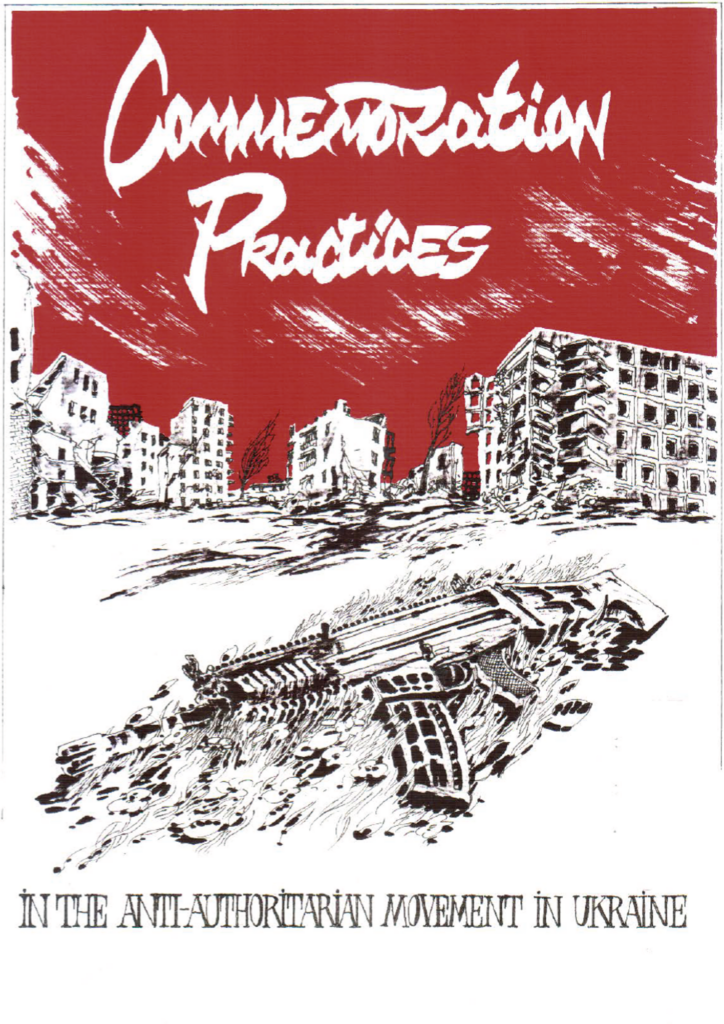
This zine was created as part of the Decolonising Cultures of Remembrance project and was produced in partnership with Educat Collective.
This zine would not exist if russia had not launched its full-scale invasion on 24 February 2022. In the face of a shared threat, the anti-authoritarian community joined forces. This is how the Solidarity Collectives came into being — people from various leftist groups joined forces to support the resistance against russian aggression. We divided our work into military and humanitarian aid, but this was less a division than different forms of the same necessity to act and provide mutual aid.
Alongside resistance, loss, and grief became part of our new reality. Over these past years, we have lost around 30 people from our community. This is roughly one person every two months. This number may seem small compared to the overall losses in Ukraine, where dozens of people are killed every day. For us, these losses are personal. We are losing friends and comrades from our movement with whom we shared values, hopes, and dreams. Together, we built radical grassroots projects, organised cultural events, attended demonstrations and gigs, and tried to change the world. Sometimes we are left with fear, anger, grief, and emptiness. However, we also have a responsibility to carry on the memory of these people and their ideas as a foundation for our movement and resistance. This is how we ensure that what they fought for and dedicated their lives to does not disappear.
In this context, culture of remembrance and archiving in Ukraine is not simply about preserving the past — it is a form of resistance, survival, and self-determination. During the war and occupation, imperial narratives attempt to overwrite our history and erase our culture, so commemoration and archiving practices safeguard the memory. They allow communities, especially marginalized ones, to document their existence on their own terms, ensuring that their voices persist even when institutions, homes, and lives are under threat.
Culture of remembrance combined with archiving is essential because culture is fragile when it is not recorded, shared, and protected. Without deliberate efforts to document stories, languages, identities, and struggles, dominant powers can easily erase or distort them. Archives give us the continuity: they connect generations, preserve truth, and create a foundation for future resistance. They are political tools that determine whose stories are remembered and whose are forgotten. Anarchists, historically and today, have faced state repression precisely because they challenge centralized power. Their histories are often fragmented, misrepresented, or deliberately destroyed. Archiving anarchist movements is thus an act of reclaiming narrative control and ensuring that the ideas and struggles are not reduced to caricatures or erased entirely.
We are faced with the questions: how do we preserve collective memory? How do we keep memories without glorification and remember them as people with their beliefs, weaknesses, and strengths?
This zine is an attempt to address these issues. We want to discuss the ways in which we try to preserve memory and history. We don’t have any ready-made answers, and even this writing is still a ‘work in progress’.
At the moment the zine is available in English. But Ukrainian and German translation is coming soon. You can download the English version of the text here: